Saving Goals for Children: Turn a Wish into an Achievable Plan
Children save more confidently when a wish is visible and the next step is small. Create motivating saving goals without pressure.

Quick answer: A useful saving goal is specific, visible and reachable within a period the child understands. Work out the price together, subtract what is already saved and divide the remaining amount into small milestones.
Start with the child’s own wish
Motivation is strongest when the goal belongs to the child. Ask what they would still want next week, not what adults consider sensible. A bicycle, book series, game or trip can all be valid learning goals.
Help compare options without taking over. A second-hand item may shorten the waiting time; a more expensive version may require patience. The choice itself is part of financial education.
Build the plan in four steps
1. Name the exact goal
“Save more” is too vague. “Save €36 for this scooter by June” creates a clear destination. Record the current price and check later whether it has changed.
2. Count the starting amount
Include cash in the saving jar and money held by parents. Make clear where the real money is kept so a digital figure is never confused with a bank balance.
3. Calculate the gap
If the goal costs €36 and €12 are already saved, €24 remain. With €3 per week, that is eight weeks—before any spending from that amount.
4. Add small milestones
Mark €18, €24 and €30 rather than showing only the distant endpoint. Each milestone gives the child evidence that the plan is working.
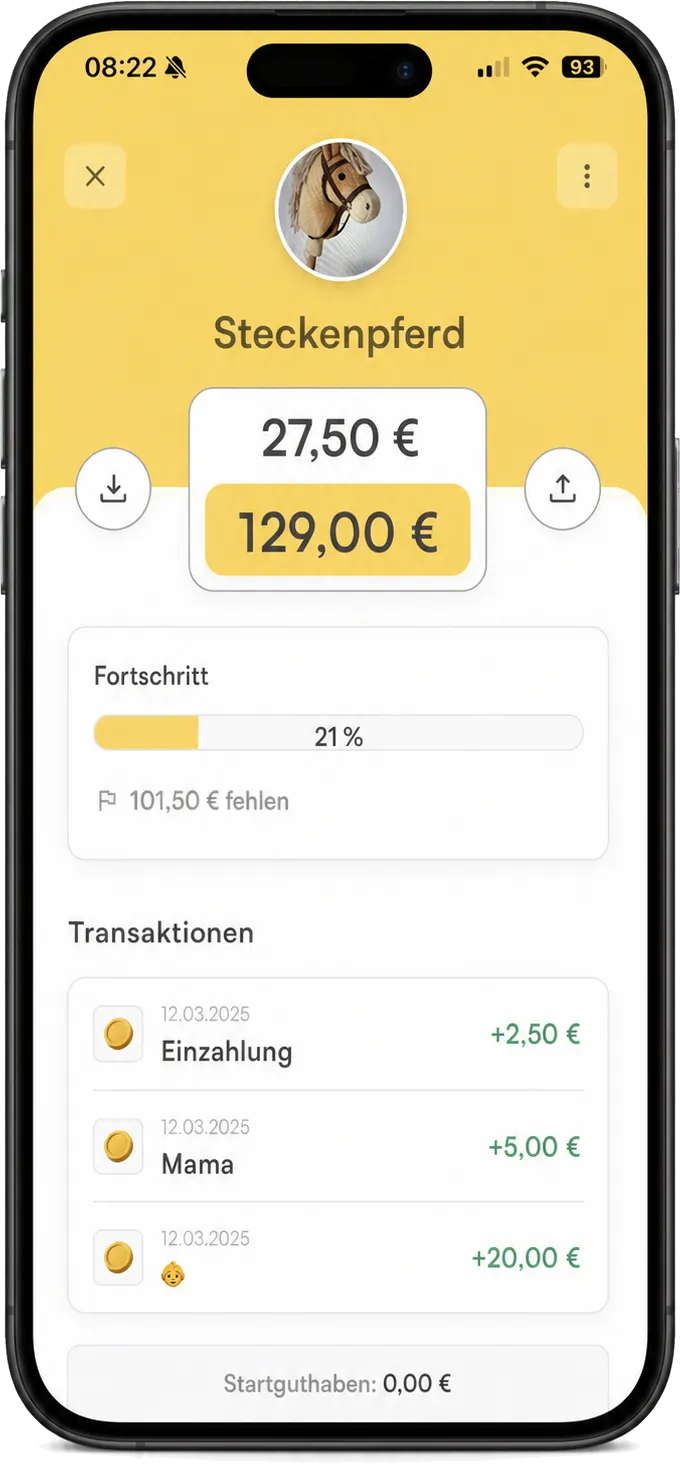
The screenshot uses the German app interface; the same principle applies in the English version. Tallo displays a virtual goal while the corresponding real money remains with the family.
How much should a child save?
There is no universally correct percentage. Younger children may start by setting aside one coin each week. Older children can choose a flexible amount after considering upcoming expenses.
A fixed minimum can provide structure, but leave enough money for present-day decisions. Saving should not make pocket money feel inaccessible.
What parents can contribute
Family support is most educational when it is agreed in advance. Options include:
- matching every saved euro up to a fixed limit,
- contributing a set amount for a birthday,
- paying the final small gap after a milestone, or
- helping the child find a safe, age-appropriate extra job.
Avoid secretly filling the goal whenever progress slows. The child then sees the reward but not the connection between planning and waiting.
When motivation disappears
Changing a goal is allowed. Ask whether the wish has changed, the time feels too long or spontaneous spending is more important right now. The child can pause, reduce or replace the goal. Money already saved remains theirs.
If a purchase repeatedly wins over saving, try a 48-hour wish list for larger items. This creates time between impulse and decision without banning either choice.
Make progress visible without pressure
A transparent jar, paper thermometer or digital progress bar can all work. Review the goal at an agreed time—perhaps once a week—not after every purchase. Praise the strategy rather than the balance: “You remembered your plan even when something else looked tempting.”
Conclusion
Saving becomes understandable when children can see the destination, the gap and the next small step. Keep the goal genuinely theirs, offer transparent support and allow them to change their mind. That is how a wish becomes financial experience rather than an adult assignment.