Pocket Money: Cash or Digital? Finding the Right Mix for Children
How cash develops a tangible sense of money while digital records support routines, history and saving goals at every age.

Quick answer: Families do not need to choose one format. Cash makes money physically understandable; a digital overview supports regular payments, transaction history and saving goals. An age-appropriate combination offers both forms of learning.
What children learn from cash
Coins and notes can be counted, sorted and seen to decrease. A young child can observe directly that spending two euros means those two euros are no longer available for another wish.
The Deutsche Bundesbank describes cash as important to children’s financial education. Its tactile nature can make purchasing power and scarcity easier to understand.
Cash is particularly useful for first independent purchases, small weekly amounts, counting change and a quick visual check of a saving jar.
What a digital overview adds
Online purchases, gifts held by parents and recurring pocket money are difficult to combine in one physical jar. An app can show when money arrived, what was spent and how far a saving goal has progressed.
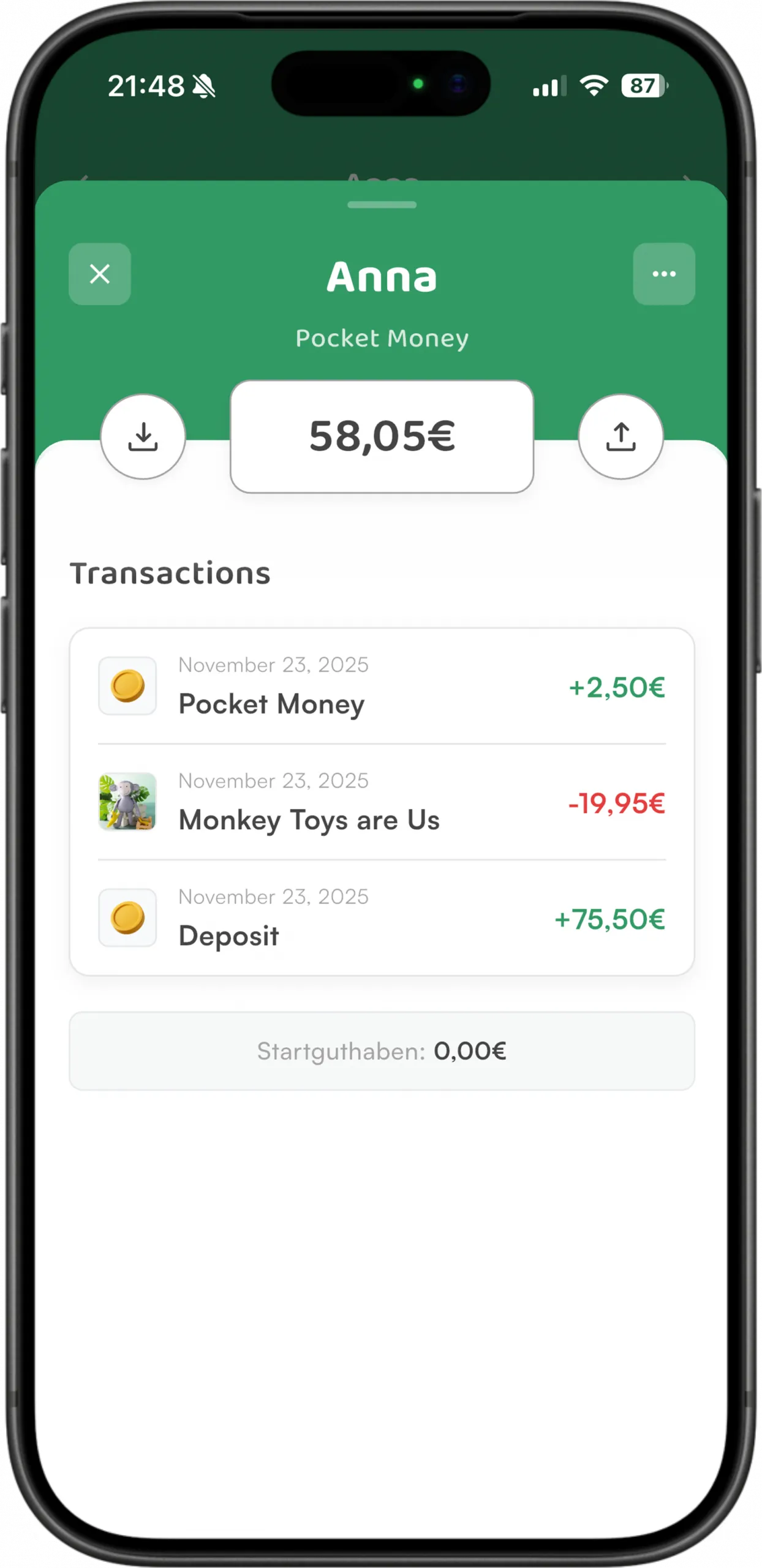
Tallo does not operate a bank account or move real money. Parents record transactions in a virtual family ledger. The child can see the agreed balance while parents retain control and custody.
A useful approach by age
Up to about nine: touch and accompany
Pay a manageable weekly amount in cash. Some can stay in the purse and some can go into a saving jar. A digital record can represent money kept safely by parents or a first visual saving goal.
From about ten: practise monthly planning
When pocket money becomes monthly, transaction history becomes more useful. A child may keep a small cash amount while parents hold the rest. Review the month together rather than commenting on every purchase.
Teenagers: explain real payment systems
Cards, online shopping and perhaps a youth account will eventually appear. Explain that contactless payment uses the same real purchasing power as cash. Balances, privacy, secure passwords and purchase confirmations become part of the lesson.
The three-pot method
Divide available money physically or mentally:
- Spend: small spontaneous wishes.
- Save: a defined longer-term goal.
- Hold: a reserve for later decisions.
The proportions can change. The useful step is deciding which pot a purchase comes from. A digital saving goal can show long-term progress while the spending pot remains in a physical purse.
Common digital pocket money mistakes
- The number stays abstract: connect it with real prices and occasional cash purchases.
- Adults correct every choice: small mistakes are part of learning.
- A virtual balance is mistaken for an account: explain where the real money is held.
- Transactions are recorded late: update them promptly so the total remains credible.
- A personal phone becomes a requirement: Tallo’s protected Kids’ View can be used on a shared family device.
Conclusion
Cash and digital records solve different problems. Start with something tangible, add digital routines gradually and always explain where the real money is. Children can then learn both the value of individual coins and the planning behind a longer transaction history.