Teaching Money to Neurodivergent Children: Clear Routines Without Pressure
How visual steps, fewer choices and flexible pauses can make everyday money decisions easier for neurodivergent children.
Quick answer: Neurodivergent children do not need a special kind of financial lesson. They need a learning environment that fits how they attend, process and communicate. Short steps, visible sequences, fewer choices and permission to pause can make money decisions clearer and emotionally safer.
Neurodivergence does not describe one learning style
Neurodivergence is an umbrella term for differences in neurological development, including attention deficit hyperactivity disorder (ADHD) and autism. Two children with the same diagnosis may have very different strengths and support needs. One may enjoy numbers and precise rules. Another may lose track of multi-step tasks, act quickly or become overloaded by noise and time pressure.
Start with observation rather than a generic technique:
- When is the child most available for a decision?
- Which format is easiest: objects, pictures, colours, written words or speech?
- What creates overload: too many choices, abstract time, noise or unexpected change?
Diagnosis and treatment belong with qualified professionals. This guide is practical family education, not medical, psychological or educational advice.
Turn money into a visible sequence
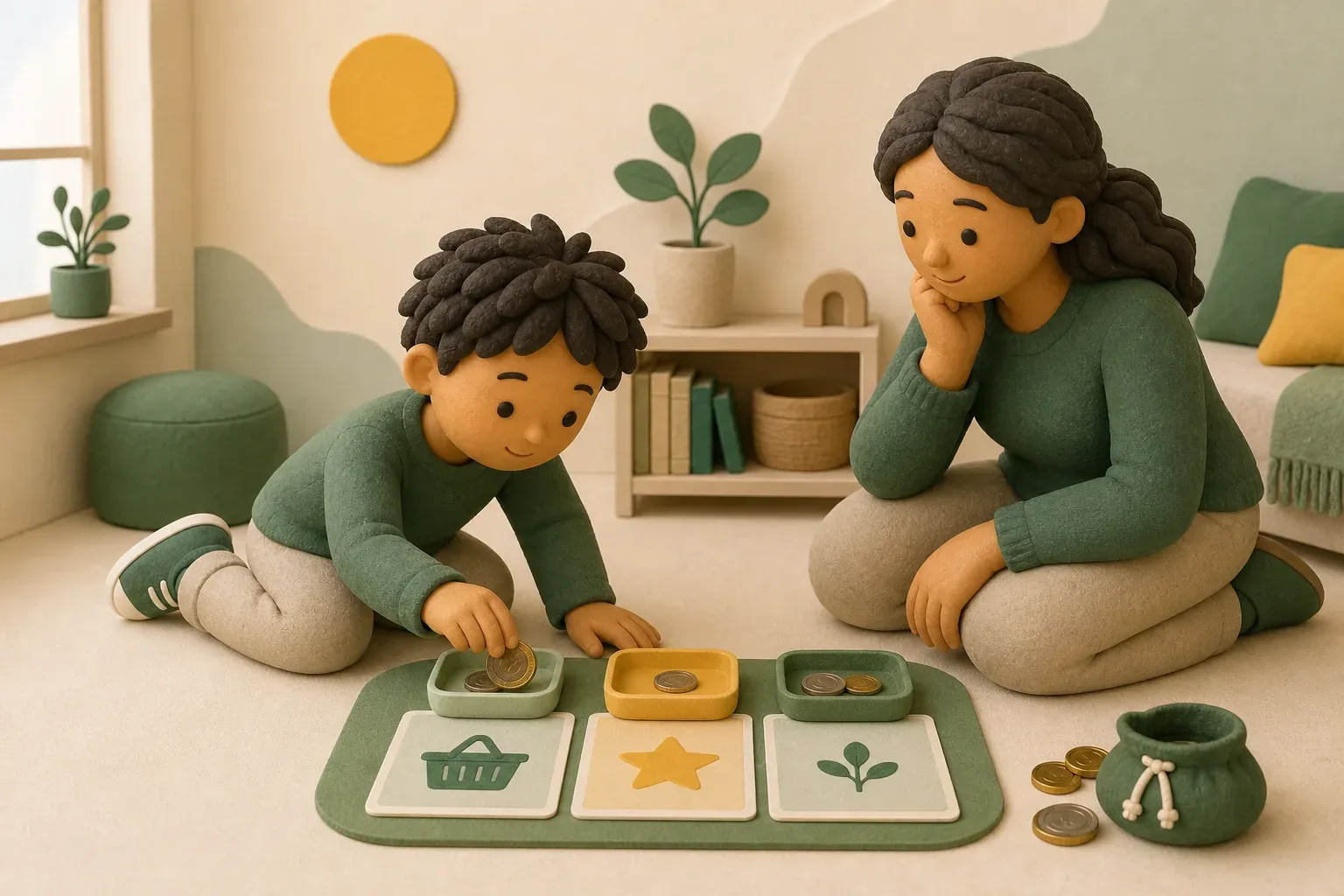
“Manage it carefully” hides several separate actions. Make those actions visible. A simple routine can use three cards or trays:
- Look: What is available?
- Choose: Use some now or keep it for a goal?
- Record: What did I decide?
Use the same colours and order each time. This reduces how much information the child must hold in working memory. The National Autistic Society recommends specific money guidelines, visual supports and colour coding for organisation. The UK National Health Service also suggests clear, simple instructions one at a time and visible to-do lists for children with ADHD.
Fewer choices can support more autonomy
“Do whatever you want with your money” may sound liberating while creating a very broad decision. Two concrete options can be easier:
- “Would you like to decide today or park the wish until Saturday?”
- “Would you like to keep two euros or five euros for the goal?”
- “Should we show the steps with pictures or coins?”
The child still makes the decision. The adult reduces the cognitive load. Only offer choices when either answer is genuinely acceptable.
Put the pause outside the child
Impulsivity is not a moral failure. ADHD can make it harder to weigh an immediate reward against a later consequence. Build a pause into the environment instead of demanding more self-control at the hardest moment.
Options include:
- photographing a wish instead of buying immediately,
- a fixed “look again tomorrow” appointment,
- a short check card showing price, available amount and current goal,
- an agreed phrase the child can use to postpone a decision without debate.
The pause should not feel like punishment. It is an external tool that adults use too.
Choose a low-stimulation moment
A crowded shop, the minutes before dinner or an active conflict all demand considerable regulation. Move reflection to a calmer setting. Ten relaxed minutes at a clear table are often more useful than a long explanation at the checkout.
Useful adjustments may include:
- one short scheduled time each week,
- only the necessary objects on the table,
- movement or a break before talking,
- allowing the child to point or show rather than speak,
- a clear finish: “Today we are deciding only about this one wish.”
Germany’s federal health portal describes routines and clear rules as potentially helpful in daily life with ADHD. It also stresses that the child’s behaviour is not intentional misbehaviour.
Record progress without constant evaluation
A visual overview can reduce uncertainty, but it should not become daily performance monitoring. Tallo can display a family-agreed virtual balance or savings goal. Tallo is not a bank account and does not hold real money; the overview is a shared memory aid.
During a review, ask about the process as well as the result:
- Which step felt easy?
- Where was there too much information?
- Which format helped?
- What should we change next time?
The family adapts the routine to the child instead of forcing the child into a rigid system.
A simple one-week starting point
Choose one situation, such as responding to a purchase wish. Make three visible steps and test them for one week. Then let the child help decide whether to keep, simplify or replace them. A small reliable routine is more useful than a perfect system nobody enjoys.
Conclusion
Money skills are easier to practise when children are not simultaneously managing sensory overload, ambiguous language and time pressure. A neurodiversity-friendly routine is concrete, predictable and adjustable. It protects autonomy rather than removing decisions.