Visible Progress: Helping Children Build Routines That Last
Why small steps, immediate feedback and visible success can support brushing, saving and other everyday routines for children.
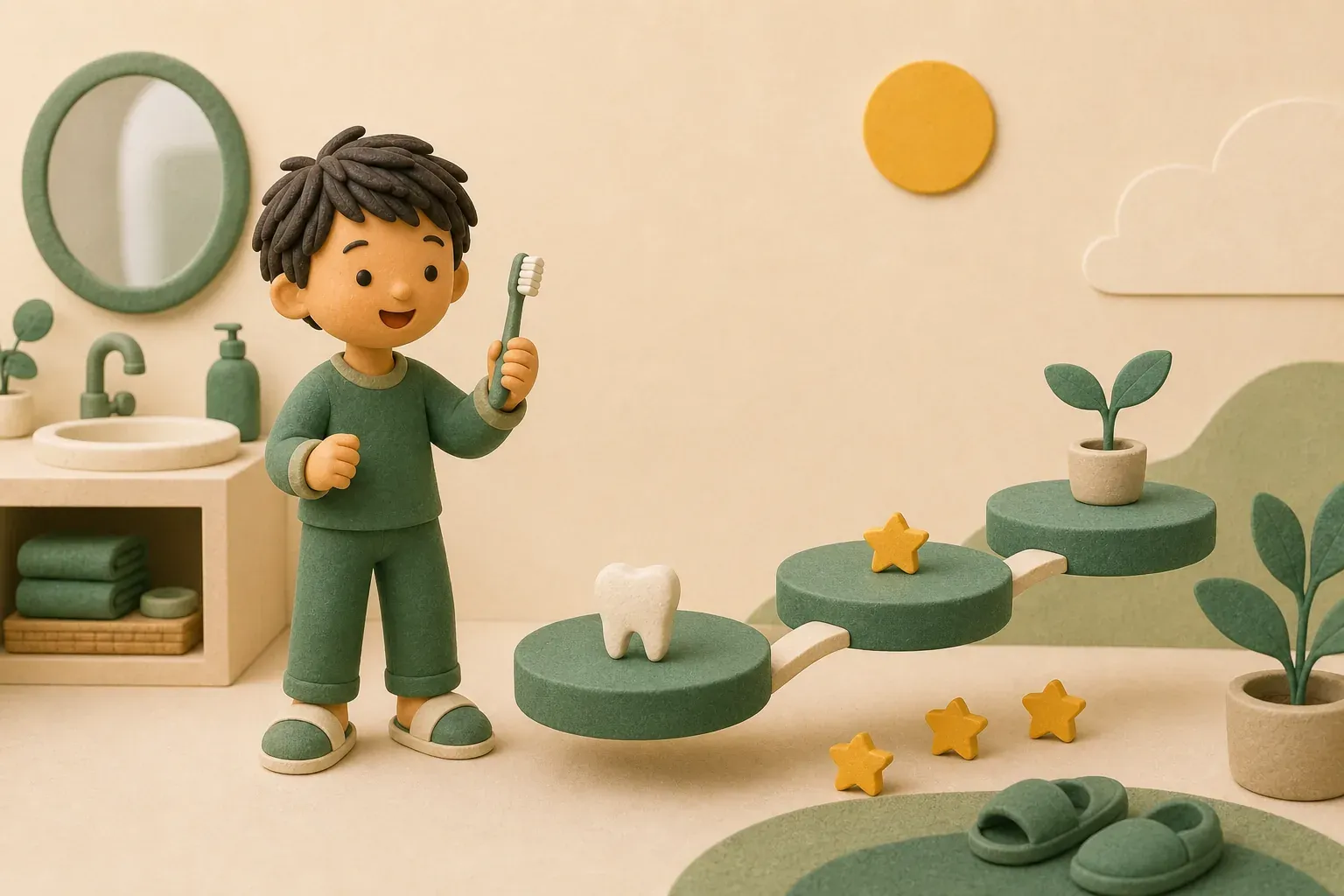
Quick answer: Children are more likely to sustain a routine when they understand the next action, see progress soon and have some influence over the design. This applies to brushing teeth, tidying up and saving. The key is not a large prize but a clear loop the child can complete.
A routine needs a visible beginning and end
“Brush properly from now on” or “Save regularly” does not describe a specific behaviour. A useful routine answers four questions:
- When does it begin?
- What is the smallest action?
- How will the child know it is complete?
- What happens next?
A savings loop might begin after money is received: look at the goal, choose a small amount and update visible progress. A brushing loop might start after breakfast: complete the guided two minutes and reveal the finished step.
Small steps beat distant promises
Long-term outcomes are difficult to feel. “Healthy teeth years from now” or “a bicycle in six months” is far away. The next small step can happen today.
Reduce the routine until the child can begin without a long explanation. An oversized target creates repeated failure. A small action provides useful information: this worked, I needed help here, and I can continue tomorrow.
Feedback should be specific and timely
The US Centers for Disease Control and Prevention explains that positive consequences work particularly well when they follow the desired behaviour promptly. Social rewards such as attention, a shared activity or specific praise can be more accessible than material prizes.
Go beyond “Well done” and name the action:
- “You started even though you were still tired.”
- “You checked the next goal step by yourself.”
- “You returned after the interruption.”
The child learns which of their own strategies helped.
A progress display is not a surveillance board
Progress should provide orientation, not publicly record every deviation. Avoid red deductions, sibling rankings and removing completed steps as punishment.
A fair display:
- preserves what has been achieved,
- makes the next step manageable,
- allows pauses and restarts,
- belongs to the child or family rather than an audience,
- can be adjusted together.
If the display creates more conflict than clarity, it is too complex or serving the wrong purpose.
Two apps and two practical progress patterns
Tallo allows children and parents to follow a family-agreed virtual savings goal. The display turns a distant wish into smaller progress steps. Tallo does not hold real money and is not a bank account.
Brushlings applies visible progress to toothbrushing. The iOS app uses augmented-reality masks to guide children aged three and over through two real brushing minutes. Brushing morning and evening for three days reveals a collectible Brushling piece by piece. According to the product page, the app has no ads or trackers, and camera images stay on the device.
Transparency note: Brushlings and Tallo are developed by the same independent product studio, Dear Friend. The examples show the same design principle in two different contexts: make progress understandable without replacing the real-world action.
Motivation should not become bribery
A reward system has gone off course when the child focuses only on the prize or refuses every ordinary responsibility without payment. Start with social reinforcement and visible progress:
- notice the success together,
- mark one step,
- describe the child’s strategy,
- let the child choose the next variation.
Material incentives can sometimes support one specific new behaviour for a limited period. They should be realistic, achievable and possible to reduce. The CDC recommends choosing concrete behaviours and adjusting the programme when the expectation is not yet within the child’s ability.
Review the routine together
After one week, three questions are enough:
- What made starting easier?
- Where was the step too large or unclear?
- What will we change next week?
The routine becomes a family experiment. The child is not a problem to optimise; the family is improving the process.
Conclusion
Visible progress works when it creates clarity, agency and an achievable next action. Whether the context is brushing, saving or the school morning, a small reliable loop is more helpful than pressure, perfection or a distant promise.